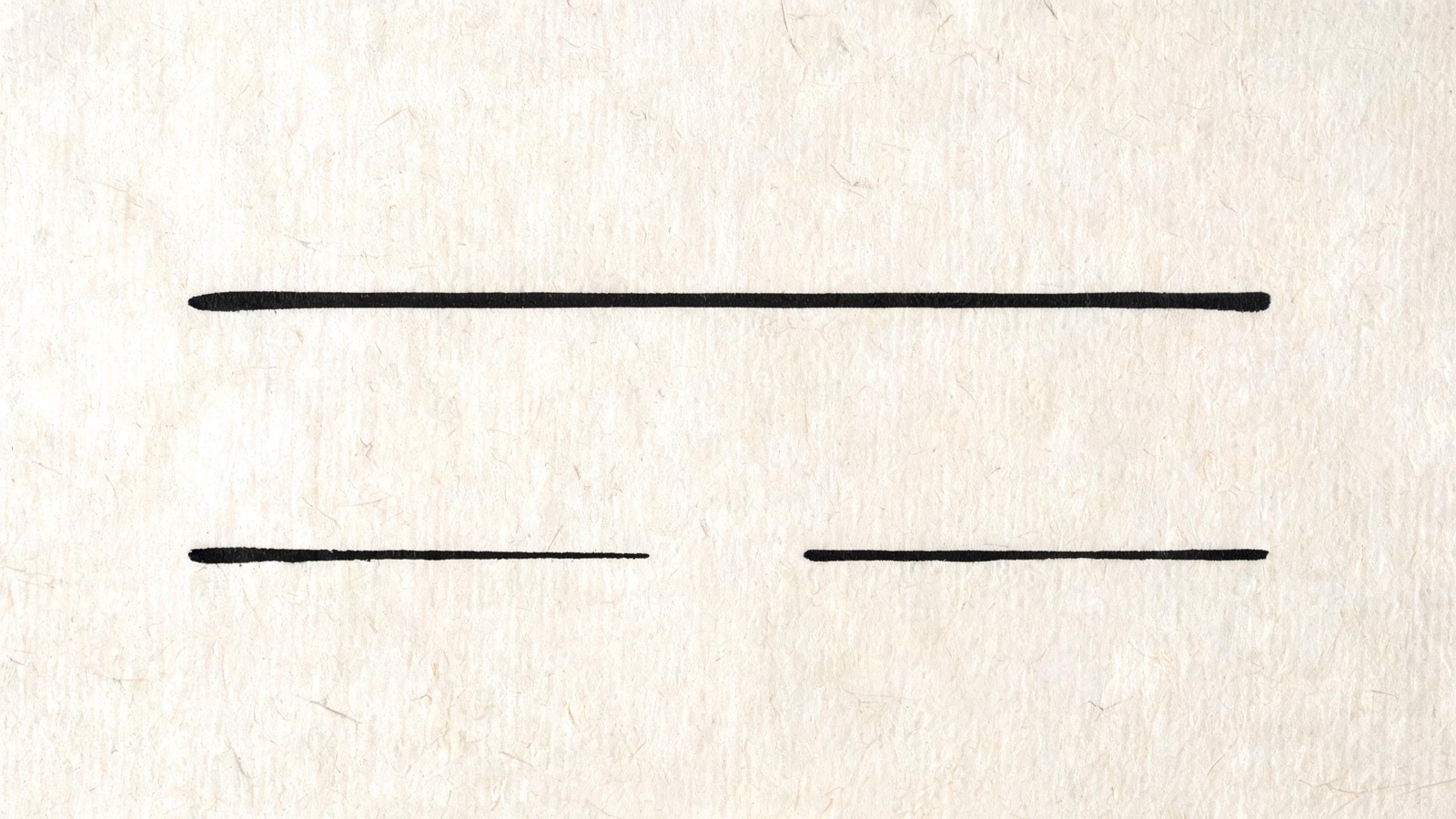
The short version
- The Yijing is a six-bit code: two kinds of line, 2⁶ = 64 states.
- Leibniz read it as binary arithmetic in 1703 — not as prophecy.
- Its symmetry rules can be checked by hand in a minute.
What the Yijing actually is
A solid line. A broken line. That is the entire alphabet.
Stack three and you get eight combinations. Stack six and you get sixty-four. Each of those sixty-four is a hexagram, with a name and a short text attached.
That is the whole structure. Everything else — the commentaries, the divination manuals, the centuries of interpretation — sits on top of a counting system.
One line = one bit
A solid line is yang (—). A broken line is yin (--).
In modern terms, each line carries one binary state: on or off. It is the smallest unit of information a system can hold — a bit.
The design constraint is familiar to anyone who has built storage: if space is expensive, your symbols must be few. Two symbols, repeated in fixed positions, is the cheapest way to record many states.
2 → 8 → 64
The eight trigrams — Qian ☰ (all solid) through Kun ☷ (all broken) — are traditionally tied to sky, earth, thunder, wind, water, fire, mountain, and lake: the basic conditions a landscape can be in.
Six lines give the hexagrams. Sixty-four states, each one a six-bit word.
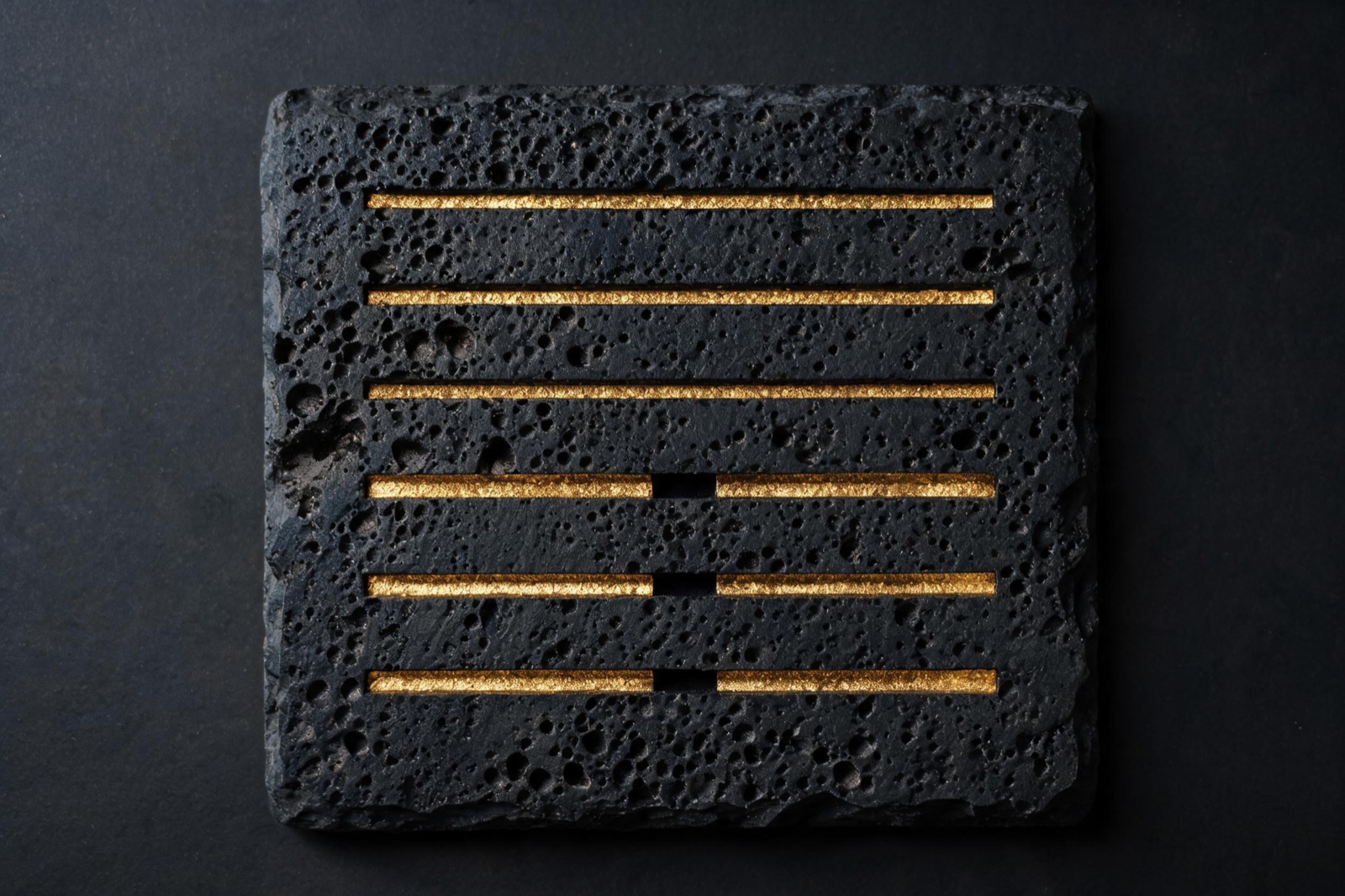
Leibniz, 1703
Leibniz had been working on binary arithmetic since 1679. He found it elegant and could not find a use for it.
Then the Jesuit Joachim Bouvet sent him a diagram of the sixty-four hexagrams, arranged in the sequence compiled by Shao Yong in the eleventh century. Leibniz assigned 0 to the broken line and 1 to the solid line, started at Kun, and counted: 0, 1, 2, 3 — up to 63. Every figure matched.
He published the correspondence in 1703. One correction to the popular retelling: he did not "discover" the Yijing, and he was not converted to any mystical reading. He was checking whether a structure was universal. That is what mathematicians do.
The symmetry you can check
Arrange the eight trigrams in a circle following the Earlier Heaven sequence. Look at each trigram and the one directly opposite:
- Qian ☰ ↔ Kun ☷
- Li ☲ ↔ Kan ☵
- Zhen ☳ ↔ Xun ☴
- Dui ☱ ↔ Gen ☶
Every line flips: solid becomes broken, broken becomes solid, in all three positions. In computing this is called bitwise complement. The pairs sum to seven: 000↔111, 001↔110, 010↔101, 011↔100.
There is a second rule in the received King Wen sequence. Read the sixty-four hexagrams as thirty-two consecutive pairs: in each pair the second is either the first turned upside down, or — for the eight symmetrical ones — the first with every line inverted. Thirty-two pairs, no exceptions. Qing scholars called it 非覆即变, "either overturned or inverted."
Both properties can be verified with a pencil. That is the point: they are checkable claims, not beliefs.
What this is not
The ancient Chinese did not predict computers. Nobody in the eleventh century was designing circuits.
What the hexagrams share with binary arithmetic is a set of constraints that appear whenever information has to be encoded compactly: a small alphabet, meaning carried by position, a fixed word length, and symmetry rules that let you generate the whole set instead of memorising it.
Different cultures, working on different problems, arrive at similar solutions. That convergence is worth noticing. It is a design lesson, not a revelation.
Why it matters for a room
If you work with space, the method transfers directly.
Describe a room with six binary distinctions: open or enclosed, bright or dim, moving or still, new or worn, hard or soft, high or low. Six decisions give sixty-four descriptions — enough to tell two similar rooms apart, few enough to hold in your head.
That is all the Yijing asks of a designer: pay attention in a structured way.
FAQ
Is the Yijing binary?
Yes, structurally. Each line has two states and each hexagram is a six-position word, so the system can be read as binary numbers 0–63. The binary reading was documented in Leibniz's 1703 paper.
Did Leibniz discover the I Ching?
No. The hexagram sequence predates him by roughly seven centuries. Leibniz recognised that it matched binary ordering and published the correspondence; he did not invent or decode the text.
Why are there 64 hexagrams?
Because six positions with two states each give 2⁶ = 64 combinations. The number follows from the structure, not from a choice about how many hexagrams to include.
What do the broken and solid lines mean?
Broken is yin, solid is yang — conventionally read as receptive and active, or as 0 and 1 in the binary reading. The assignment is a convention; what matters mathematically is that there are exactly two states per position.
Is this the same as feng shui?
No. The Yijing is a text and a notation; feng shui is a set of spatial design practices that later borrowed from it. They share vocabulary, not a mathematical identity. Zhaiji uses the notation as a design vocabulary, not as a predictive system.
Interested in these objects for your own space?
Zhaiji sources Chinese-aesthetic furniture and objects for international clients. Tell us what you are looking for — we come back with options, lead times, and a quote.
Request a sourcing quoteZhaiji
Chinese-aesthetic living, sourced with care.